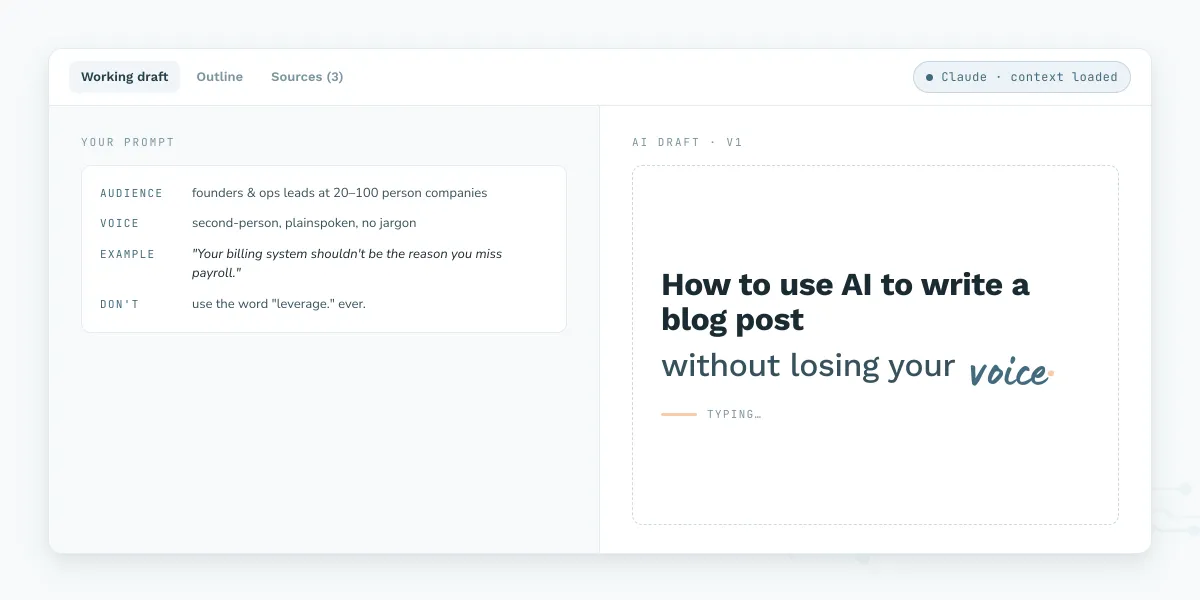
Using AI for Blogging Without Losing Your Voice
SEO Blog Writing, AI Writing Tips, Blog Post Structure
How to Use AI to Write a Blog Post Without Losing Your Voice
Most people open ChatGPT or Claude, type something like 'write a blog post about X,' and get something that reads like it was written for everyone and no one at the same time. The output is technically correct. It is also completely forgettable.
This is not a tool problem. It is a structure problem.
AI does not know your business, your voice, or your clients. It knows patterns. When you give it nothing to work with, it fills the gap with generics. When you give it context, constraints, and a clear direction, the output changes significantly.
This post walks through how to actually use AI to write a blog post, including what to prepare before you open the app, how to prompt well, and where to keep your own judgment in the process.
Start before you open the app
The most common mistake is treating AI as the starting point. It works better as a production tool than an idea generator, at least when it comes to content that is supposed to sound like you.
Before you write a single prompt, get clear on three things.
1. What is this post actually about
Not just the topic. The specific angle. 'How to use AI to write a blog post' is a topic. 'What most people get wrong before they open the app' is an angle. The more specific your angle, the better AI can execute it.
Write one sentence that describes exactly what the reader will understand after finishing the post. If you cannot write that sentence, you are not ready to prompt yet.
2. Who are you writing for
Your ideal reader is not 'small business owners.' It is the business owner who has been running on memory and caffeine for three years, is skeptical of anything that sounds like a magic solution, and wants to know if this is actually worth their time.
The more specific your reader, the more specific your prompts can be. Generic reader, generic output.
3. What do you want the reader to do or think after reading
Every post should have a purpose. That purpose does not have to be a sale. It might be that the reader understands something differently, or trusts you more, or saves the post. Know what you are trying to accomplish before you ask AI to help you accomplish it.
How to prompt well
A good prompt is essential to getting good results AND having AI write your blog without it reading like AI. I asked Julie from P&W Designs, my SEO Strategist & Web Designer, what her best practices look like as I start writing my own blogs. As she’s taught me, in order to be seen online, yes you need to write for the individual, but you also need to write for search. One thing to note, as of the time of this blog, Julie did mention that AI does NOT work for keyword research. If you want to learn about keyword research, and how you can confirm you are using words people are searching for, check out her podcast, Coffee & Conversions, or her blog - both linked.
Back to prompting: A good prompt is LONG and gives all the context it needs in order to write for search and the user. Here’s her best practices:
Here is a framework that works
I need you to write a blog post for my business.
TOPIC: [Insert topic, working title, or core question the post answers]
PRIMARY KEYWORD: [Insert target keyword]
SOURCE MATERIAL (if applicable): [Paste transcript, outline, voice note, rough draft, or bullet points here. If starting from scratch, write "none."]
---
BRAND VOICE + WRITING STYLE
* Write in first person ("I")
* Voice: [describe yours if it's not already coded in — e.g., "warm and direct, a little cheeky, zero corporate energy"]
* Sound like a knowledgeable friend, not a textbook
* Reading level: 7th–8th grade
* Short paragraphs (3-5 sentences max)
* Intentional line breaks for skimmability
* No em dashes (use commas, periods, or parentheses instead)
* No fluff, no filler, no throat-clearing intros
---
WHO I'M WRITING TO
Write every line as if I'm talking to ONE person — my ideal reader. Do not generalize to "business owners" or "anyone who..." Keep one specific person in mind the whole way through.
---
CONTENT REQUIREMENTS
* Open with a strong, relatable hook — a pain point, a "that's so me" moment, or a rhetorical question that sets up the topic
* Make the reader feel seen in the first 2–3 sentences
* Deliver the core value in a story-driven, conversational way
* Use their language, not mine — write how they'd actually describe the problem
* If source material is provided, pull direct quotes where they add personality or credibility
* After every major point, ask "so what?" — make sure each section ties to a clear benefit for the reader
* Weave the primary keyword in naturally (no stuffing)
* Include 2-3 relevant internal lnks within the blog
---
SEO STRUCTURE
* H1: Blog title using the primary keyword (keep it clear over clever)
* H2s and H3s: Supporting sections using related keywords
* Optimize for both Google search and AI-based discovery
* Include a meta description (150–160 characters) that makes someone want to click
* Provide a short list of suggested SEO Titles
---
OPTIONAL SECTIONS (include only if they fit naturally)
* 1–2 real examples or mini case studies
* A "Practical Takeaways" section in bullet points
* An FAQ section with 2–3 questions a real person would Google
---
CONCLUSION
* End with a confident, encouraging close that reinforces what my brand stands for
* Include a TLDR (Too Long Didn't Read) section at the very end — bulleted, skimmable, covers the main points
* Clear CTA: tell the reader exactly what to do next [e.g., inquire, download the freebie, read a related post, DM me]
---
BEFORE YOU WRITE, do these three things:
1. Tell me in one sentence who you understand the reader to be
2. Tell me the ONE main point this post will drive home
3. Give me the H1 + 3 alternate headline options
Then wait for my go-ahead before writing the full post.
That prompt is doing real work. It is not just naming a topic. It is giving AI a reader, a tone, a structure preference, and a set of things to avoid.
For Informed Tech Solutions specifically, I add: 'Do not use exclamation points. Do not use the words seamless, easy, or game-changing. Write like a systems strategist, not a marketer.'
Those constraints matter. Without them, AI defaults to the most common pattern it has learned, which is usually marketing copy that sounds like everyone else.
Pro tip: Create a skill that ChatGPT or Claude can use over and over again so you don’t have to keep pasting in the same prompt every week.
Use AI for the draft, not the final version
Once you have a solid prompt, use AI to generate a draft. Read it as a starting point, not a finished product.
The things AI tends to do well:
Structure and sequencing
Covering the obvious points so you do not have to start from scratch
Suggesting transitions between sections
Producing a readable first pass quickly
The things AI consistently gets wrong:
Your specific examples and client situations
Your actual voice and word choices
The nuance that comes from doing this work for years
Knowing when something sounds like you versus when it sounds like everyone
Go through the draft and replace the generic with the specific. Add the real example. Cut the sentence that sounds like a LinkedIn post. Put back the thing AI softened because it was too direct.
The goal is not to publish what AI wrote. The goal is to publish faster than you could without it.
Pro tip: once the blog is drafted, run it through zerogpt.com and ensure that it’s not flagging more than 50% for AI.
A practical workflow, step by step
Here is how I approach this when I use AI for blog content at Informed Tech Solutions:
Step 1: Write my angle and my one-sentence reader takeaway on paper or in a notes doc. This takes five minutes and saves thirty.
Step 2: Write the prompt using the framework above. Include the audience, the tone, what to avoid, and any specific points I want covered.
Step 3: Run the prompt and read the draft.
Step 4: Rewrite the sections that sound off. Usually this is the introduction, any place AI tried to be encouraging, and the conclusion.
Step 5: Add one specific example or story from my actual work. This is what makes the post real.
Step 6: Read it aloud. If you stumble, the sentence is wrong.
What this tells you about your content process
If you find that every post requires heavy rewriting, one of two things is happening. Either the prompts lack structure, or you do not yet have a documented voice and content framework that AI can reference.
The businesses that get the most out of AI for content are the ones that have defined their voice, their audience, and their messaging before they start prompting. AI accelerates what already exists. It does not create the foundation.
Tools without structure create more chaos. This applies to content as much as operations.
If your content process depends entirely on starting from scratch every time, or on remembering what your brand sounds like from post to post, that is the real problem. AI will surface it faster than it solves it.
The short version
AI is useful for blog content when you bring a clear angle, a specific reader, and a defined voice to the process. It produces a working draft quickly. You bring the real examples, the final voice, and the judgment about what stays.
The output will always reflect the quality of the input. That is true of AI. It is also true of most things in business.
If your content process, like many business processes, is running from memory rather than structure, that is worth looking at.
Make sure to subscribe to my newsletter for my tech tips.
View services at informedtech.io/services